
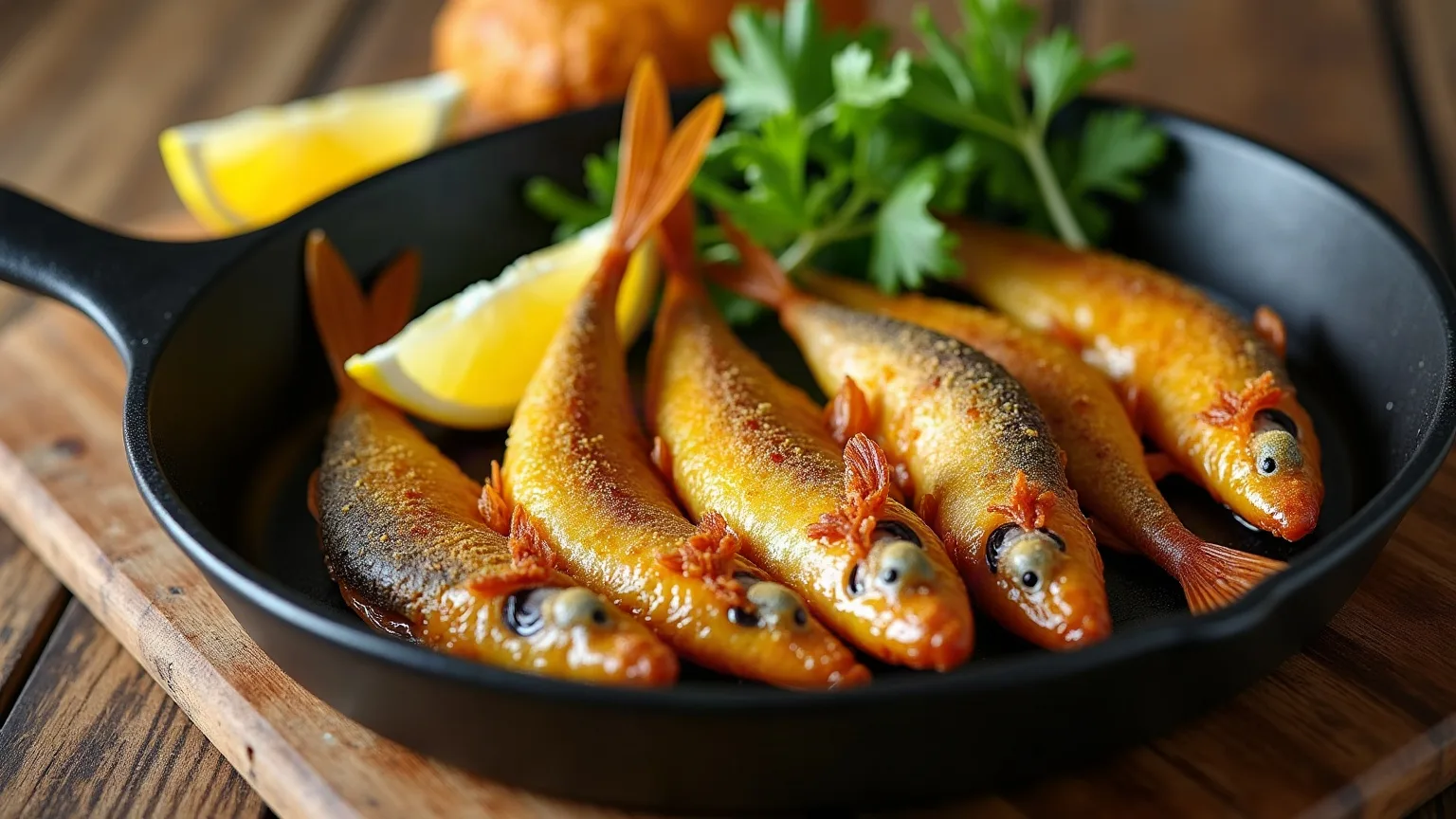
Fried anchovies
Cornmeal is not flour: its coarse grains fry into a glassy crust, and the anchovy steams inside it.
Fish and seafood · Black Sea · Under 30 minutes · Budget · Seasonal
- Preparation
- 20 min
- Cooking
- 10 min
- Difficulty
- Needs attention
- Cost
- Very cheap
- Season
- Autumn, Winter
The Black Sea fries its anchovies in cornmeal, and that is as much a technique as a tradition. Cornmeal takes up less water than wheat flour and its grains are coarser; in oil it dries and crisps rather than gelling. Coated in wheat flour, an anchovy gets a soft, doughy crust. And the fish itself cooks in two minutes — which for a 12 cm fish is already generous.
Method
- Clean the anchovies: pull the head off, open the belly and draw the backbone out from the tail.
- Rinse them in cold water and drain them ten minutes in a sieve.
- Dry them on paper: a wet anchovy does not take the cornmeal, it pastes it.
You will need: A wide deep pan · A sieve and kitchen paper
-
Salt the dried anchovies, then turn them in the cornmeal and shake the excess off.
Look for A thin, even dusting: a thick coat turns doughy.
Why The salt goes on BEFORE the cornmeal: sprinkled over the coating it stays there and the fish itself is unseasoned. Shaking the excess off matters too, because loose meal burns in the oil.If it went wrong
A pasty coating means they were not dry enough. Shake it off in a sieve, dry them again and coat them in fresh cornmeal.
Starch still asleep The granules are just floating there doing nothing. No body arrives before 62 °C.
Salt · 0.84% Right in the window. Flavours sharpen, bitterness retreats, water is held.
-
Bring the oil to 180 °C and fry them in a single uncrowded layer, one minute a side.
Look for The coating should go golden and the fish float separately without sticking.
Why An anchovy is very thin and completely cooked in two minutes; by the third the flesh breaks up into the oil. A crowded pan drops the temperature and the coating drinks fat instead of crisping.If it went wrong
If they fall apart the oil was cold or the pan crowded: take it to 190 °C and halve the batch size for the rest.
Starch gelatinised The granules soaked up water, swelled and burst into a network. It has thickened, and it will firm further as it cools. no way back
Maillard is running Amino acids have met reducing sugars. The crust, the roasted flavour and that smell all come from here. no way back
Frying dynamics Surface water is flashing to steam and pushing outward — that is the shield keeping the oil out. no way back
Salt · 0.67% Right in the window. Flavours sharpen, bitterness retreats, water is held.
-
Lift them out, lay them on paper and serve them AT ONCE.
Look for No large oil stain on the paper.
Why Once out of the oil the cornmeal crust starts absorbing the fish’s own steam, and within five minutes the crispness is gone. This recipe does not tolerate waiting.Starch gelatinised The granules soaked up water, swelled and burst into a network. It has thickened, and it will firm further as it cools. no way back
Salt · 0.63% Right in the window. Flavours sharpen, bitterness retreats, water is held.
This recipe was run through the engine step by step — what goes in when, and at what temperature and for how long. The reactions above come from that run.
peak 180 °C · 16 minutes · engine 1.0.0 · confidence low
What can go wrong here
The fried food went soggy and oily⌄
What happened
The oil was not hot enough. Surface water never flashed to steam and never pushed outward, so no shield formed and the oil walked straight in.
By the numbers
Hold the oil at 170–190 °C. Do not crowd the pan; every batch drops the oil 10–15 °C, so let it recover in between.
Without a thermometer
Drop in a cube of stale bread: golden in 30–40 seconds means 180 °C. Dark in 15 seconds is too hot; longer than a minute is too cold. Or stand a wooden spoon handle in the oil — a steady stream of small bubbles around it means you are there.
After the heat goes off
Very hot with plenty of lemon, cornbread and a rocket salad. Eaten the minute it is plated.
One day in the fridge with the crispness gone. Anchovy is not a fish cooked to be kept.
Five minutes at 200 °C on a rack; some of the crispness returns.
Not once cooked. Cleaned raw anchovies keep two months.
Being boneless, the leftovers go into bread or are eaten cold as a meze.
Anchovy is a good fish for children: small, high in omega-3 and low in risk once boned. For 12–36 months crush each one with your fingers to check, and halve the salt. Frying rules it out for a baby under one — bake the same fish eight minutes at 180 °C instead.
- Wholegrain cornmeal → Flour Wheat flour works but the crust comes out soft and doughy; the Black Sea’s insistence on cornmeal is about texture rather than taste.
- Deep frying The method this recipe rests on
- European anchovy What it does in heat, water and acid
- Sunflower oil (linoleic) What it does in heat, water and acid
- Wholegrain cornmeal What it does in heat, water and acid
- Fried squid Similar method, or something that sits on the same table
- Under 30 minutes Other recipes that answer the same need
- Budget Other recipes that answer the same need
- Seasonal Other recipes that answer the same need
What it tastes like
The axes that define this recipe: richness 52, umami 49, salty 30.
This profile is computed rather than measured: the role-weighted average of its ingredients’ taste vectors, shifted by what the cooking does. The thin line is the database average on that axis.
Closest in taste
Not hand-picked: ranked by distance across the eight taste axes.
Cheese omelette
The colour of an omelette is a choice: pale means a low flame and brown means a high one, and the second is an accident.…
Mıhlama
Cornmeal, butter and a cheese that stretches. The stretch is not a knack but a temperature: past 70 °C it stops stretchi…
Courgette fritters
A mücver made without squeezing the courgette falls apart. One courgette gives up half a glass of water, and with that w…
Fried courgette
Salt the slices and wait twenty minutes: the water that comes out is the only reason a fried slice spits and goes soft.…