
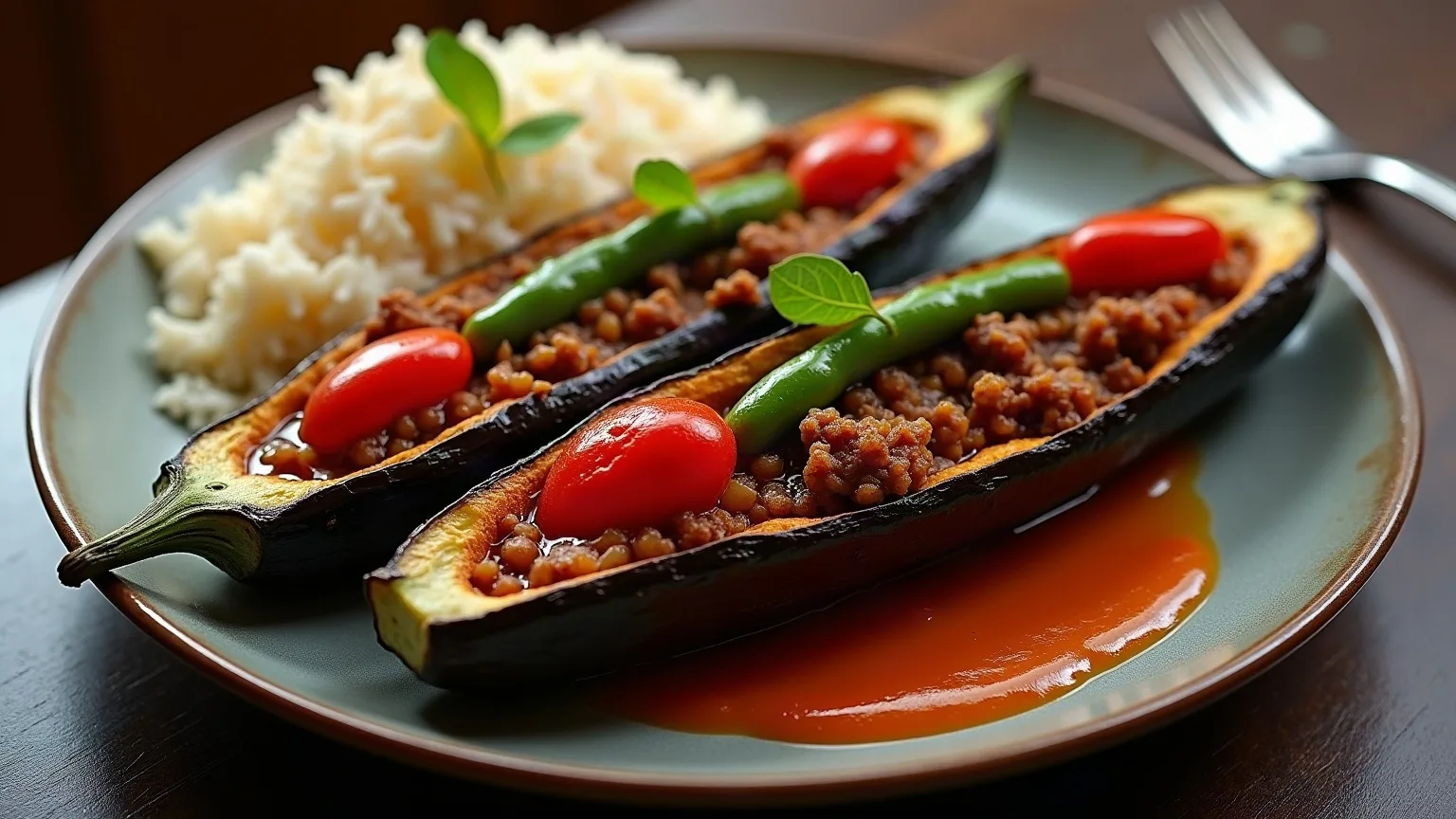
Karnıyarık
The one thing that stops an aubergine drinking oil is a soak in salted water: cells full of water leave no room for fat.
Meat dishes · Turkish · For guests · Seasonal
- Preparation
- 30 min
- Cooking
- 45 min
- Difficulty
- Practised hand
- Cost
- Middling
- Season
- Summer, Autumn
Karnıyarık and imambayıldı are the same aubergine two ways — one with mince and hot, the other in olive oil and cold. The sponge structure of an aubergine is air pockets, and in a fryer those pockets fill with oil: an aubergine can take up to 30% of its own weight in fat. Salted water fills them first, so there is nowhere for the oil to go. It is one of the most measurable interventions in a kitchen.
Method
- Peel the aubergines in stripes and soak them twenty minutes in a litre of water with 20 g of salt, weighed down with a plate.
- After the soak, dry them THOROUGHLY on kitchen paper.
You will need: A wide pan · An oven dish · A deep bowl
-
Fry the dried aubergines three minutes a side until soft and coloured, and lift them onto kitchen paper.
Look for They should go golden brown and not spring back when pressed. There should be no large oil stain on the paper — if there is, the soak was skipped.
Why The salted soak does two things: it fills the cell spaces so oil cannot enter, and it draws bitter compounds out by osmosis. The drying matters too — a wet aubergine spits and its surface never colours.If it went wrong
If they have drunk oil, give them ten minutes on a tray at 180 °C before the oven step: some of the fat comes back out. Do not skip the soak next time.
Frying dynamics Surface water is flashing to steam and pushing outward — that is the shield keeping the oil out. no way back
-
Soften the onion in the same oil for six minutes, add the mince and cook eight minutes until it has released and reabsorbed its water.
Look for The sizzle should return and the grains of mince brown individually.
Why Mince releases water first, and until that water has gone no Maillard happens. Of the eight minutes the first five are the water leaving and the last three are the browning.Starch gelatinised The granules soaked up water, swelled and burst into a network. It has thickened, and it will firm further as it cools. no way back
Frying dynamics Surface water is flashing to steam and pushing outward — that is the shield keeping the oil out. no way back
-
Add the garlic, one tomato, the paste, the parsley and the salt, and cook three minutes more.
Look for The filling should be moist rather than wet, and hold together on a spoon.
Why The parsley goes in at the last moment: cooked long it loses both colour and smell, and the filling tastes of nothing but mince.Starch gelatinised The granules soaked up water, swelled and burst into a network. It has thickened, and it will firm further as it cools. no way back
Salt · 0.46% Low. Everything reads flat and nothing steps forward.
-
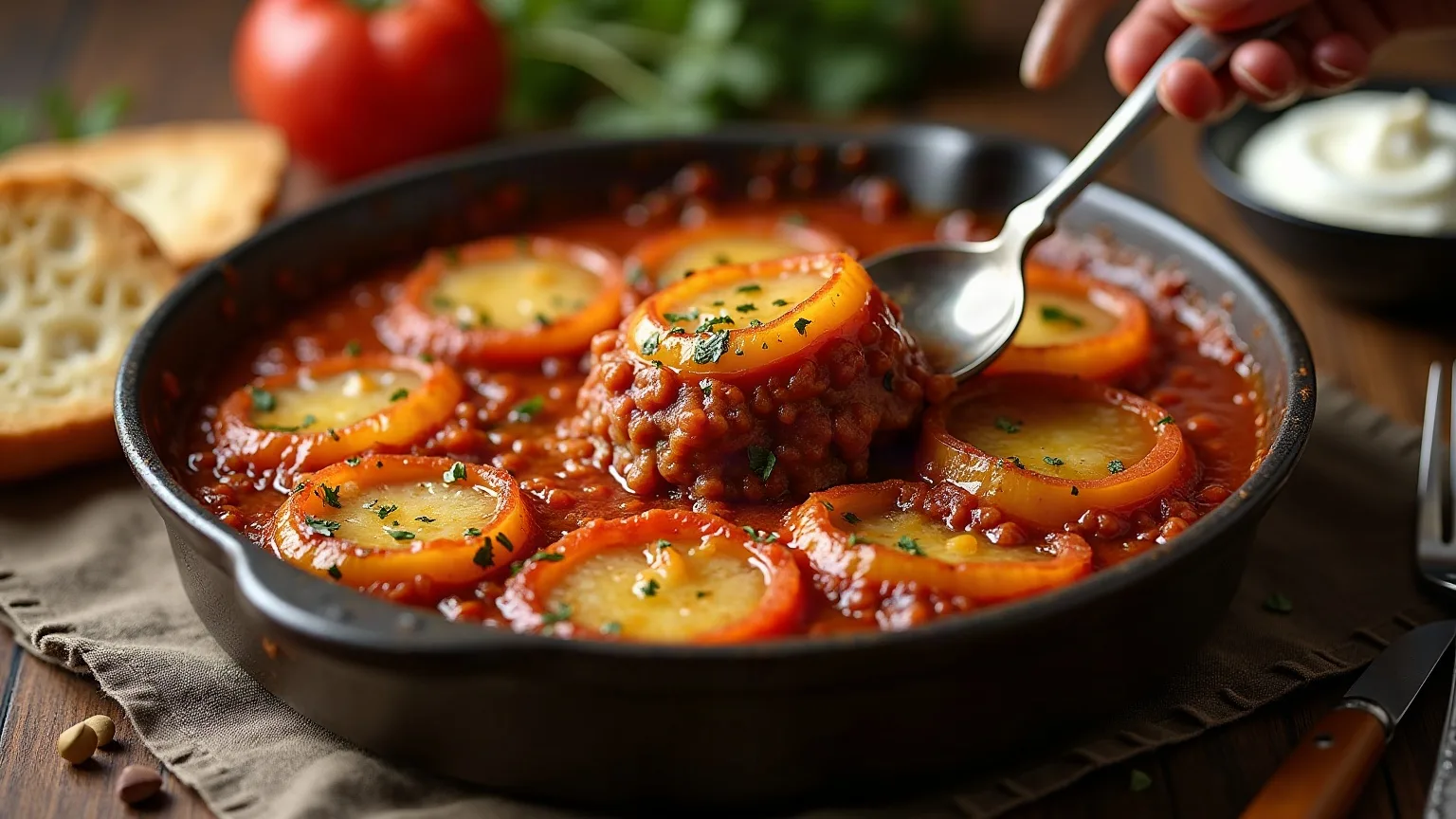
Lay the aubergines in the dish, split them open, fill them, and lay a slice of tomato and a pepper on each.
Look for The filling should sit inside the aubergine without spilling over the sides.
Why The split must not reach the base: with the base intact the filling does not run out in the oven.Salt · 0.36% Low. Everything reads flat and nothing steps forward.
-
Pour the hot water into the base of the dish and bake twenty-five minutes at 200 °C.
Look for The pepper skins should blister, the tomatoes shrink, and there should still be a little liquid in the dish.
Why The water is there for steam: the pepper and tomato on top cook without the base of the aubergine burning. Dry, the underside chars in twenty-five minutes.Starch gelatinised The granules soaked up water, swelled and burst into a network. It has thickened, and it will firm further as it cools. no way back
Salt · 0.33% Low. Everything reads flat and nothing steps forward.
This recipe was run through the engine step by step — what goes in when, and at what temperature and for how long. The reactions above come from that run.
peak 200 °C · 60 minutes · engine 1.0.0 · confidence low
What can go wrong here
The aubergine drank all the oil⌄
What happened
Aubergine flesh is a sponge with air trapped between the cells. Hot oil fills those pockets within seconds — it is not absorbed so much as inhaled.
By the numbers
Salt it for 20 minutes and squeeze out the water. Or skip oil altogether: at 200 °C in the oven the cells collapse before they can take any on.
Without a thermometer
After salting, press it between two plates with a weight on top to draw the water faster. In a hurry, soak it in milk for 10 minutes: the milk fills the pores so there is no room for oil. Pat it properly dry before frying — wet aubergine spits and drinks even more.
After the heat goes off
Hot, with rice. The liquid in the dish is spooned back over: that sauce is half the dish.
Three days in the fridge and better on the second: the aubergine takes on flavour as it sits in the sauce.
Fifteen minutes at 180 °C under foil, with 50 ml of water added.
Two months. The aubergine loosens a little after thawing, though in the sauce it is not noticeable.
Chopped into a pasta sauce, or mashed as a börek filling.
Suitable from twelve months: soft and without heat. For 12–36 months take the pepper off and give them the aubergine without skin — even the striped peel is hard for a toddler to chew. Lift their share before the salt. For a baby under one, mash aubergine and tomato without the filling.
- Beef mince (15% fat) → Lamb Lamb mince is fattier and stronger, and the classic pairing with aubergine is in fact lamb.
- Sunflower oil (linoleic) → Olive oil Olive oil works, but its smoke point is lower: drop the flame a notch.
- The oven The method this recipe rests on
- Aubergine What it does in heat, water and acid
- Tomato What it does in heat, water and acid
- Beef mince (15% fat) What it does in heat, water and acid
- Musakka Similar method, or something that sits on the same table
- Ali Nazik Similar method, or something that sits on the same table
- İzmir meatballs Similar method, or something that sits on the same table
- For guests Other recipes that answer the same need
- Seasonal Other recipes that answer the same need
What it tastes like
The axes that define this recipe: umami 45, aroma 59, sweet 26.
This profile is computed rather than measured: the role-weighted average of its ingredients’ taste vectors, shifted by what the cooking does. The thin line is the database average on that axis.
Closest in taste
Not hand-picked: ranked by distance across the eight taste axes.
Lamb casserole
The meat has two hours and the vegetables have forty minutes. Put them in together and the vegetables vanish while the m…
Chicken casserole
Made with thigh, and there is no alternative: breast certainly dries over forty minutes in an oven.…
Prawn casserole
The prawns go in for the last four minutes. Cooked with the sauce from the start they turn to rubber, and there is no wa…
Potato and mince bake
Without a pre-cook the potato slices boil rather than brown over forty minutes in the oven.…